
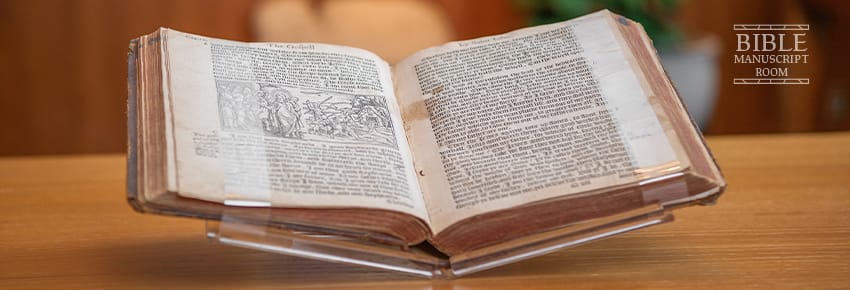
“What does this mean?” William Tyndale asked the scholars he studied under at Cambridge, pointing at a Greek phrase. An accomplished pupil, Tyndale had previously attended Oxford and had become fluent in seven languages. “And what does that mean?” While he emulated the priests, they couldn’t explain the deeper meanings behind the Greek text, nor did they know the Greek alphabet. Also at the time, the upper class attending the high church of England preferred hearing the Bible read in Latin, disregarding English, the spoken language of the common people.
Seeing the church leaders unable and unwilling to make the Scripture plain to the congregation, Tyndale recognized the value of an individual reading and understanding the Bible independently and determined to see an English copy in hands of the common people. “If God spare my life ere many years,” he said to one who did not support him, “I will cause a boy that driveth the plough shall know more of the scripture than thou doest.” In the end, Tyndale gave his life for this cause, and 500 years later English speakers and believers continue to benefit from his immense sacrifice.
Why English?
King Henry VIII had refused to give Tyndale permission to pursue an English translation, forcing Tyndale to escape to Europe and dedicate countless hours on his project there. Some time after Tyndale finished translating the New Testament from the original Greek text in 1526 and despite much opposition, this translation set a portion of history in motion.
To translate the Bible into an accurate English version was Tyndale’s ultimate goal. “That was not his way of saying he’s keeping it formal,” clarified Sherri Lefmann the archivist/curator at the Rebekah Horton Library on the Pensacola Christian College campus. “But appropriate for the Word.” As he labored, Tyndale coined phrases including my brother’s keeper, apple of his eye, whiter than snow, and terms from the original Hebrew such as Jehovah, scapegoat, and more, which are still used today.
“Tyndale’s translation work is pivotal for the English-speaking world.”
Dr. Karl Stelzer has been teaching Bible courses for almost 30 years and appreciates its rich history. “God was providentially laying the foundation for the 1611 KJV, which was the primary English Bible for 400 years,” he said. “Tyndale’s translation work is pivotal for the English-speaking world.”
Preserving Scripture
The Rebekah Horton Library has a room dedicated to historical artifacts and Bibles. Over the years, Dr. Arlin and Beka Horton curated this collection through gifts, donations, and select purchases. These items are carefully preserved and on display in the Bible Manuscript Room.
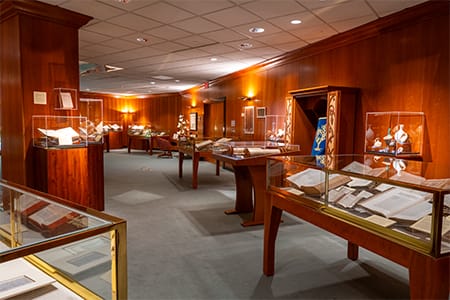
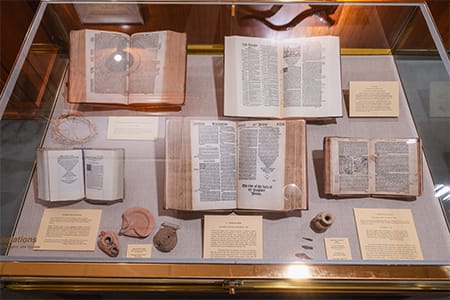
Ordered chronologically in the space, the timeline begins with a Hebrew torah scroll, a Greek NT translated by Erasmus, later followed by a polyglot (multilingual) Bible and a 20-volume braille set. One of the more central glass-encased displays contains a first edition facsimile of Tyndale’s the English New Testament, representing the one that is now 500 years old. Only two known original copies of this NT have survived the multiple attempts to destroy them all. The final case contains personal Bibles that belonged to William Booth, Paul Neill, and Florence Nightingale, as well as an indestructible NT from a man exiled in Siberia for his faith. Overall, the room is a visual reflection of the College’s biblical emphasis while preparing students to be a light for Christ in their future careers and ministries.
“When guests step into the room, they are in awe of the beauty and are immediately reminded of God’s promise to preserve His Word for future generations.”
Linda Hubbart, one of the library team members, frequently guides tours through this special collection. “When guests step into the room, they are in awe of the beauty and are immediately reminded of God’s promise to preserve His Word for future generations,” she said. “With a sense of reverence and profound appreciation, guests learn about the tremendous cost behind the preservation of the Bible they hold in their hands.”
Timeless Value
Individuals from around the world come to visit the Bible Manuscript Room—from prospective students and their families, conference speakers, to local Christian schools and homeschoolers on field trips, and many more. Bible professor Dr. Rob Small teaches a church history course that requires his students to tour the library’s collection of Bibles and artifacts and complete a report. “As we close our study of the dark ages under the Roman Catholic Church, we pivot to the great men used by God to preserve and translate the Bible into the English language,” Dr. Small said. “Often, students didn’t know the room existed until this assignment. I regularly receive feedback from them that they thoroughly enjoyed it and learned so much!”
Director of guest services Jon Tutton shares what the preservation of God’s Word means for Christians. “The manuscripts represent more than historical documents; they remind us that believers across many generations valued Scripture enough to carefully copy and protect it. Being able to help guests see that legacy is both encouraging and meaningful.”
“The manuscripts represent more than historical documents; they remind us that believers across many generations valued Scripture enough to carefully copy and protect it.”
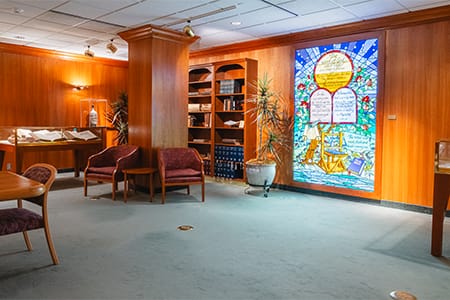
The preservation of God’s Word continues quietly in the Bible Manuscript Room. In between visits, another retelling of William Tyndale’s influence, and the accounts of other lives sacrificed for us to own a Bible today, the curator carefully manages the collection. Then the Environmental Services team painstakingly follows with a weekly cleaning schedule. “Maintaining the Bible Manuscript Room requires careful but intensive attention to cleanliness and detail,” supervisor Kaitlyn Quinlan said. “We make sure the space remains dust-free and as spotless as possible. We work carefully around the display cases and artifacts, keeping them safe and presentable for visitors.” Kaitlyn considers her work an honor, recognizing that her team plays a real part in reverencing God’s Word. “My desire is that through our ministry, we can properly present Christ and bring many to Him or encourage others to grow in awe of His precious word.”
Five hundred years ago Tyndale completed an English translation of the New Testament, a work of lasting consequence for English speaking believers. The labor of love that cost Tyndale his life has changed the lives of thousands and, as long as the Lord allows will continue to influence many more.
“The grass withereth, the flower fadeth: but the word of our God shall stand for ever.”
Isaiah 40:8